In construction of any building on land, one needs to make sure that their piles could work well during loading. In order to produce piles that strong enough, you need to do soil testing in order to design size of piles or choosing types of piles (bored pile or driving pile). There are two methods in order to test soil in construction work that: 1. SPT (Soil Penetration Test) The Standard Penetration test (SPT) is a common in situ testing method used to determine the geotechnical engineering properties of subsurface soils. It is a simple and inexpensive test to estimate the relative density of soils and approximate shear strength parameters. Description and Testing Procedure Standard Penetration Test, SPT, involves driving a standard thick-walled sample tube into the ground at the bottom of a borehole by blows from a slide hammer with standard weight and falling distance. The sample tube is driven 150 mm into the ground and then the number of blows needed for the tube to penetrate each 150 mm (6 in) up to a depth of 450 mm (18 in) is recorded. The sum of the number of blows required for the second and third 6 in. of penetration is reported as SPT blowcount value, commonly termed "standard penetration resistance" or the "N-value". The N-value provides an indication of the relative density of the subsurface soil, and it is used in empirical geotechnical correlation to estimate the approximate shear strength properties of the soils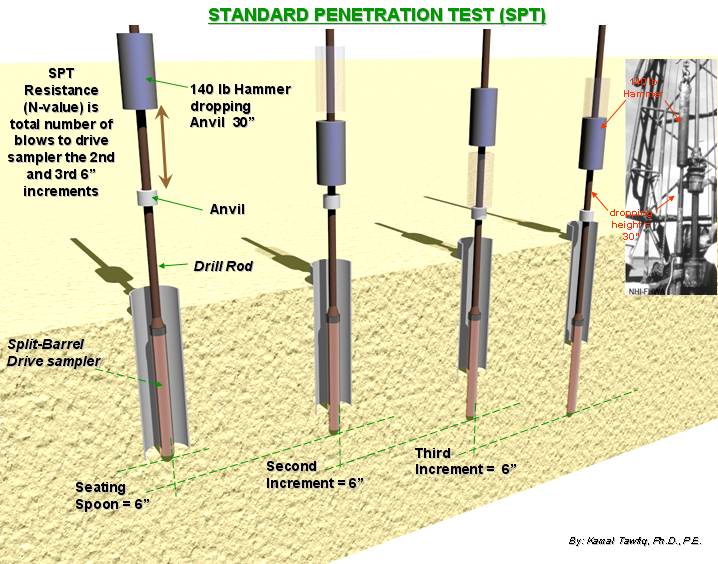 2. Dynamics Test ............................................................................................................................................................................................................................... |
